
We are Unstoppable, Another World is Possible By Maya Best

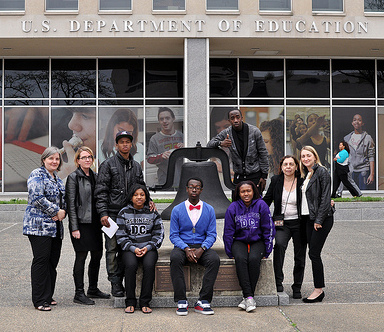
If you turn onto Ellsworth Avenue in Pittsburgh, Pennsylvania, you might come across a big house standing between two tall green trees. This is the Pittsburgh Friends Meeting House where the American Friends Service Committee’s Racial Justice Through Human Rights youth program meets twice each month on Sunday afternoons to learn about the importance of human rights and equality. The group is run by Scilla Wahrhaftig, the program director at the Friends Meeting House. The students come from different social and economic backgrounds, attending a number of different high schools around the city. This program is a great way for students to communicate and share their opinions and ideas with one another.  

Already having accomplished their goal of making the city of Pittsburgh a Human Rights City on April 19th 2011, the group has completed a new project. Back in December and January, they participated in the “If I Had a Trillion Dollars” (IHTD) youth video competition that asks students what they would do if they could spend a trillion dollars on anything. A trillion dollars is spent every year on the U.S military and the wars in Iraq and Afghanistan, causing other things to fall to lower levels of importance. The youth group worked non-stop and created a stop motion film called “Educating Hope,” using Legos and other props to express the importance of education.  

The Pittsburgh Public school system is struggling with continuous budget cuts and lower funding, and many students are getting a poor education. The video strives to show people the importance of education and how it sets up a lifelong path for students. In this film, a high school boy is forced to change schools in his senior year because his old school has shut down. He ends up dropping out of school and joining the military. Students should not feel the need to make bad choices in life. They then showed the boy’s life path with a trillion dollars invested in education. As stated at the end of the film, “Education is the key to success.” http://www.afsc.org/video/educating-hope-if-i-had-trillion-dollars


The film was chosen for the IHTD contest and was shown at the annual film festival in Washington D.C. The group traveled to Washington from April 13th to 15th to participate in the annual IHTD leadership training organized by the American Friends Service Committee. The students learned about military spending and prepared for their meeting with members of Congress. They had the opportunity to express their concerns about funding for education when speaking with the aides of Senator Toomey and Senator Doyle. To wrap things up, the group helped to perform an action on the Washington mall where they held up poster boards showing the current military action budget, and their ideal budget if one trillion dollars went into other categories, chanting, “We are unstoppable, another world is possible.” It was a wonderful experience and they hope to attend the event next year. Now the youth group will continue to help out in the community by starting an art project that will demonstrate their views on fracking and how it affects the environment.


Maya Best, youth participant in Racial Justice Through Human Rights youth program

Why the time really is now – demand cuts to Pentagon spending!

Did you get sick of hearing about the fiscal cliff a couple months back?  So did I.  But here’s the deal, talk over spending cuts still aren’t over.  And though the partial agreement that Congress came up with was less than satisfactory for those of us who want to see the wealthy and corporations pay their fair share, something neat did happen.  A tiny door was left open.

All that’s left to discuss are cuts to spending.  We can’t talk about alternative sources of revenue or ending the Bush era tax cuts, because our lawmakers took those off the table.  But you know what’s still on the table?  Cuts to Pentagon spending.

It’s too early to celebrate, since if the automatic cuts (that congress just delayed last month) do go into affect on March 1st, we will still see $31.4 billion in cuts to domestic programs like WIC, Head Start, child care, housing, home energy, and homeless aid, education and training.  Medicare will be cut by $11.2 billion.  Our communities, and in particular those who are already most vulnerable in US society, will suffer.

But we have this brief window now where we can really make the case that it’s the Pentagon’s turn.  The Pentagon budget includes billions for programs that are wasteful and unnecessary.  The F-35 fighter jet for example, costs $1.5 trillion (yes, TRILLION!) for a fleet, but military generals themselves call them an “epic boondoggle.”  We should end that program altogether.  And our tax dollars are lining the pockets of defense contractors.  The average salary of a top 5 defense contracting CEO last year was $21.5 million(higher than almost any other CEO on Wall Street). There has never been a proper audit of Pentagon spending, ever. Meanwhile vets returning from our endless wars are left to fend for themselves and the VA is severely under-funded.  Our spending priorities are all out of sorts!

So in the next month its our job to put our feet into that crack that’s been left open, and shove the door open wide.   We can create economic vitality and real security by investing in jobs for young people, transforming our education system or investing in green energy and jobs, as these youth filmmakers suggest in their entries for the 3rd annual ‘If I Had a Trillion Dollars’ Youth Film Festival.  We can move our money from the pockets of wealthy defense contractors and into our struggling communities.  The time to cut pentagon spending is now.

Fed up with our federal spending priorities? Build your own budget!

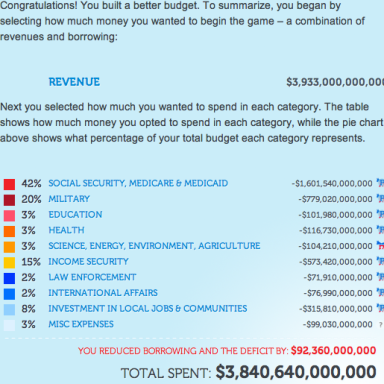
I just built a better budget, a budget that reflect my spending and revenue priorities, based on real budgets proposed by Budget Committee Chair Paul Ryan and the House Republicans, President Barack Obama and the Democrats, the non-partisan Office of Management and Budget, or the House Congressional Progressive Caucus (CPC). Creating a better budget is a lot easier than I thought, which makes it hard to understand why Congress is unable to get the job done on schedule.

Check out the “Build A Better Budget” tool, make your own budget and share with your members of Congress and friends.


Screen shot 2012-12-06 at 11.17.53 AM

‘The House I Live In’ – an IHTD intern’s review.

Last weekend, I saw ‘The House I Live In,’ a documentary by Eugene Jarecki on the War on Drugs.  If you see any movie this year, see this one.

The obvious reason IHTD followers should check out this film is that we’ve spent over $1,000,000,000,000 (that’s a trillion dollars) fighting this endless, ineffective, and racist ‘War on Drugs’ since 1971.  Last year, the federal government alone spent over $25 billion enforcing the War on Drugs, and requested an increase in funds for FY2013.  That’s $25 billion that could go towards housing subsidies, towards college scholarship, towards keeping schools open.

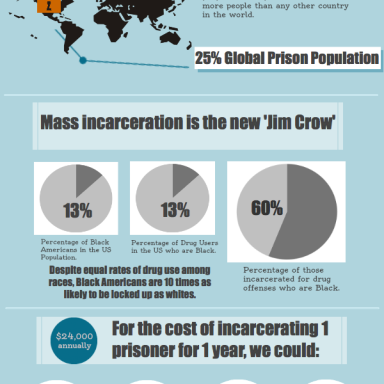
‘The House I Live In’ is also a fantastic intro to understanding how mass incarceration has become ‘the New Jim Crow‘ in the U.S.  Black people make up over 60% of all who are incarcerated for drug offenses, despite the fact that drug use has been shown to be relatively equal among races, and Black Americans make up only 15% of the US population.

Author Michelle Alexander is featured throughout, and reveals the stark reality that there are more Black people imprisoned now than were enslaved in 1850.  The war on drugs has lead to the formation of a frightening new system of racialized control in the US.

While watching the film, I was moved by powerful images from inside, and gripping stories from prisoners and their families.  Walking out of the theatre, I couldn’t help but imagine where we could be today if all of those resources were spent on healing, rather than locking people up, separating families, and inflicting militarized violence on whole communities.  What if instead we focused on healing individuals, healing our communities, and healing society at large?

If I Had a Trillion Dollars is a film festival that aims to get young people to share their visionary ideas for how our federal resources could be better spent than on things like militarism and tax cuts for the wealthy.  Eugene Jarecki may not be 10-23 years old, and the 108 minute film definitely goes over our 3 minute limit, but I encourage you to see it nonetheless.  Heck, the Boston Globe thinks it’s your civic duty to watch it.

If I Had a Trillion Dollars I’d end the War on Drugs.

IHTD Blog: Why youth and the federal budget?

Young people are a huge sector of US society, whose voices are largely ignored by those who set the policies and make the laws. According to the 2010 U.S. Census, there were 40,717,537 youth age 10-19 in the United States – that’s 14% of the total U.S. population. As one participant put it, “It’s important that adults understand that we are being affected by the decisions that are made for our country.”

And young people across the country certainly are feeling the effects of an economic and political system that benefits the wealthy and corporations at the expense of everyday, working people. Here are just a few examples:

The jobs crisis. In July 2011, the number of unemployed youth was 4.1 million, which puts youth unemployment at 18.1% (acc. to the Bureau of Labor Statistics). That’s more than double the national average.

The student debt crisis continues to ensnare an entire generation of college-bound young people with the nightmare of never-ending payments. The Federal Reserve estimates that outstanding student loan debt has surpassed $1,000,000,000, and college dropout rates are on the rise.

And we can’t leave out the attacks on public education in general, which have severely impacted children of color, and youth living in low-income communities. 60% of the federal budget goes to military spending, while a mere 6% is allocated towards education. And when states spend more than 3 times as much per prisoner as they do per public school child, as is the case in Illinois, no one suffers more than the young people (especially youth of color) being stripped of their potential and pushed into the school-to-prison pipeline.

Despite all of the devastating social and economic crises affecting the lives of young people in the US, social theorist Henry Giroux points out that “Children have fewer rights than almost any other group and fewer institutions protecting these rights. Consequently, their voices and needs are almost completely absent from the debates, policies, and legislative practices that are constructed in terms of their needs.

But what if their voices and needs were central to the discussion around our federal spending priorities?

Why ‘If I Had a Trillion Dollars?

The ‘If I Had a Trillion Dollars’ Youth Film Festival asks young people, ages 10-23, to share their opinions, ideas, and visions for the discretionary spending portion of the federal budget. The festival is geared towards educating and inspiring young people to engage in civic activism. With IHTD, young people have the opportunity to learn about federal priorities, explore their own priorities, and potentially travel to Washington D.C. to share their opinions with legislators themselves.

And on another level, the festival gives adult allies in the movement the chance to listen to and learn from young people about the most important issues affecting their lives. By circulating youth-produced short videos and creating a national audience for IHTD, we are able to integrate the diverse voices and ideas of visionary young people into the nation’s debate about the budget and federal spending.

It’s time to stop ignoring, and start listening, to the voices of kids, teenagers and young adults as we figure out how to solve the multitude of problems facing this country. Spread the word about ‘If I Had a Trillion Dollars’ with a young person you know today.